Audit and Smith
The Audit and Smith panel provides deep diagnostic critique and multi-agent reasoning reviews for complex clinical cases.
What it does
This tool offers cognitive decision support by auditing consultation documentation against evidence standards. The Smith module acts as an independent diagnostic reviewer, presenting alternative clinical explanations and identifying potential diagnostic blind spots or premature cognitive closure.
When to use it
Use Audit and Smith when reviewing difficult diagnostic dilemmas, chronic unresolving symptoms, or cases with conflicting clinical signs.
Step by step
- Select Audit from the tool rail to open the diagnostic evaluation drawer.
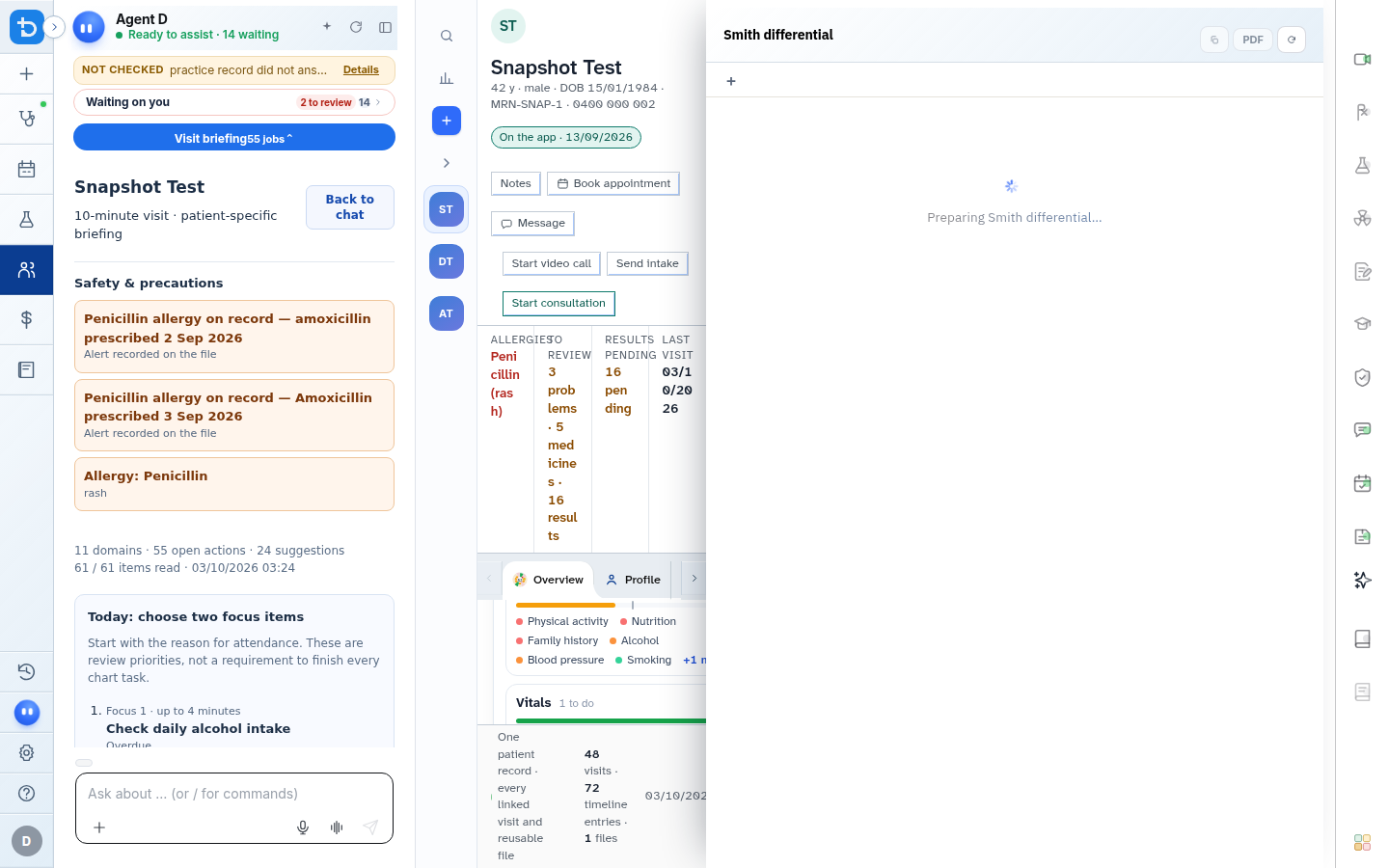
- Review independent diagnostic reasoning and cognitive checkpoints.
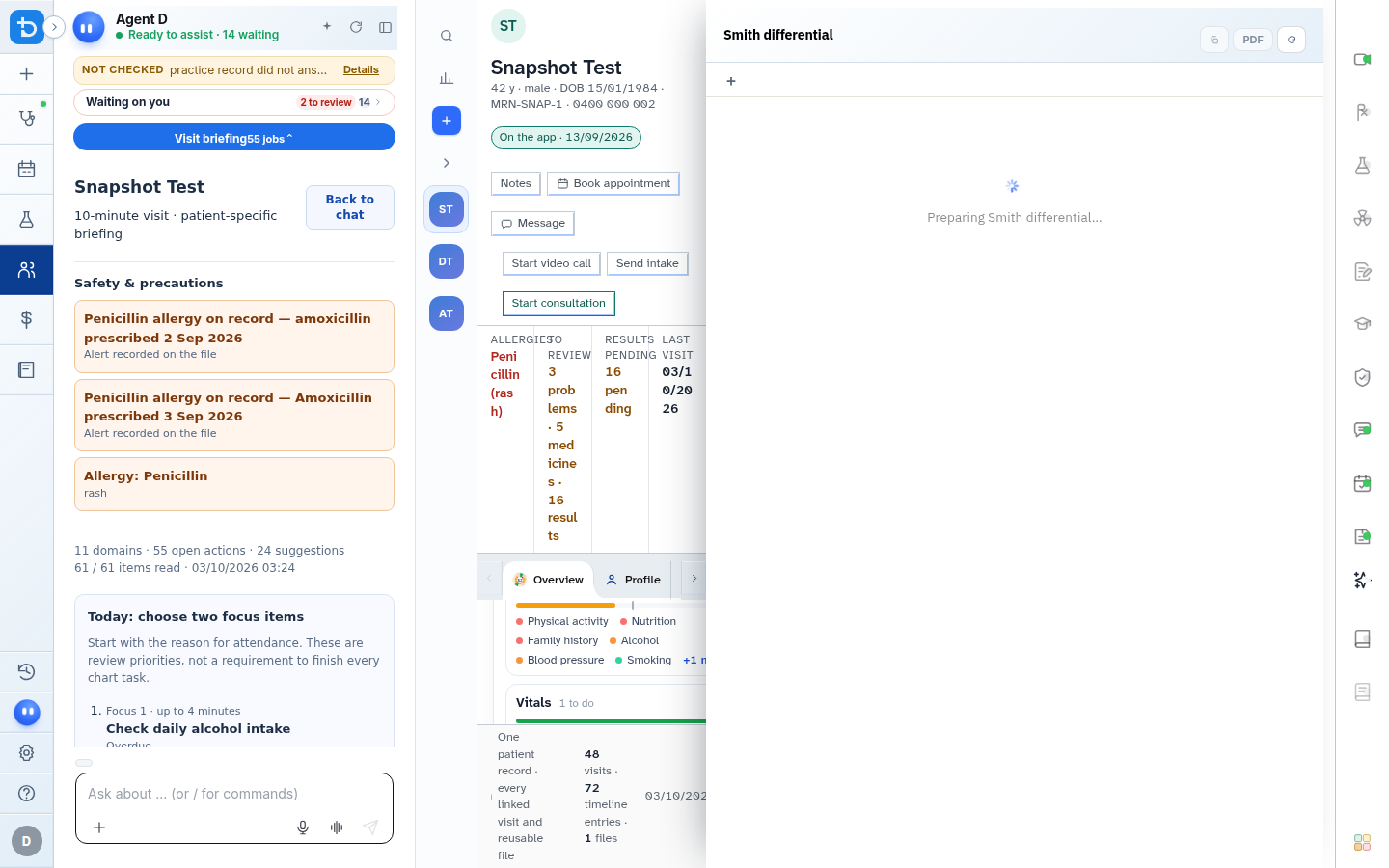
Also on this screen
- Audit read panel: Summary evaluating diagnostic thoroughness, recommended investigations, and documentation completeness.
- Smith multi-agent review: Alternative clinical perspectives designed to challenge assumptions and prevent cognitive bias.
- Diagnostic blind spots: Highlights atypical presentations of serious illnesses that could mimic common benign conditions.
- Checklist verification: Evaluates whether essential red flags and vital signs have been adequately documented.
What Agent D can do
- Agent D runs secondary reasoning checks across multiple clinical domain models to identify uncommon diagnoses.
- Agent D benchmarks documentation against published quality-of-care criteria.
Safety (what needs your Confirm)
- Audit and Smith evaluations are reflective clinical decision aids. Final diagnosis and care management rest with the doctor.
- Suggestions provided in the audit panel never alter patient records without your approval.
Common questions
What is the purpose of the Smith module?
Smith provides an adversarial, second-opinion perspective to help clinicians avoid cognitive biases such as anchoring or availability bias.
Will running an audit change my written notes?
No. The audit evaluates your documentation in a separate review drawer and never overwrites your consultation notes.
When is it most useful to consult Smith?
It is especially valuable in patients with atypical presentations, recurring unexplained symptoms, or when treatments have failed to produce expected progress.
Related
Last reviewed: 03/10/2026.